Mastering Budget Espresso: 5 Pro Tips for Your Sub-$100 Machine
Welcome to the world of home espresso! The market for inexpensive, sub-$100 espresso machines has exploded, offering a plethora of options for aspiring...

- Coffee Basics Nerds
- 7 min read
Mastering Budget Espresso: 5 Pro Tips for Your Sub-$100 Machine
Welcome to the world of home espresso! The market for inexpensive, sub-$100 espresso machines has exploded, offering a plethora of options for aspiring baristas. While many of these machines might look different, they often share similar internal components and functionalities. The good news is that an affordable price tag doesn’t mean you have to settle for subpar coffee. With the right techniques, you can pull delicious, cafe-quality shots from even the most budget-friendly models. This guide will break down the essential anatomy of these machines and provide five expert tips to elevate your home brewing game.
Before we dive in, let’s establish two ground rules for this guide. First, we won’t be physically modifying or taking apart any machines. Our focus is purely on technique-driven improvements that can be applied across various models. Second, this guide assumes you already have a coffee grinder capable of producing a fine, espresso-appropriate grind. The world of grinders is a complex topic for another day, so for now, we’ll proceed as if you’re all set with freshly ground coffee.
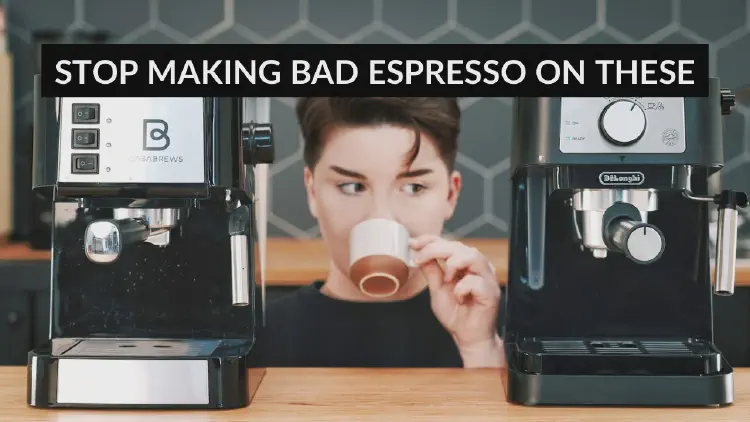
Today, we’re looking at two popular budget options: the Casabrews CM5418 on the left and the De’Longhi Stilosa on the right. While they have minor differences in their controls and accessories, their core functions of pulling espresso and steaming milk are very similar. We’ll explore their components and then use the De’Longhi for our brewing demonstrations.
Let’s start with the portafilter, the handle that holds your coffee grounds. Budget machines often showcase two different styles. The De’Longhi features a more traditional design with a wire spring inside the rim; this spring creates tension to hold the coffee basket securely in place, even when you’re knocking out a used coffee puck.
The Casabrews portafilter, on the other hand, lacks this internal spring. This means the basket can easily fall out when you turn it over. To solve this, it includes a small plastic thumb lever that you can flip out to hold the basket in place while discarding the grounds. It’s a small difference but highlights the kind of variations you’ll find in this price range.
These machines also typically come with a plastic multi-tool that serves as both a coffee scoop and a tamper. The scoop side is for measuring coffee (though we’ll discuss a better method), and the flat bottom is for tamping, or compressing, the coffee grounds in the portafilter. We’ll revisit this tool and its challenges in our tips section.
Beyond the accessories, the machines themselves are quite straightforward. They are primarily built from plastic but often feature a metal plate on top that acts as a passive cup warmer. You’ll find a removable water tank on the back, a removable drip tray at the front, the group head where the portafilter locks in, and a steam wand for frothing milk. The controls are located on the front, with a separate knob to activate the steam function. It’s important to note that these machines are single-boiler, meaning you cannot pull an espresso shot and steam milk at the same time; there’s a short preheating time required when switching between functions.
Now that we understand the basic anatomy, let’s get into the five tips that will transform your coffee.
Tip 1: A Gram Scale is Non-Negotiable
To pull good espresso on a cheap machine, you need a gram scale.
This is the single most crucial tool you can add to your setup. While scoops are provided, they are incredibly inconsistent. Espresso brewing relies on precision, and a scale that measures to at least a tenth of a gram allows you to control exactly how much coffee goes into your basket and how much liquid espresso comes out. This control is the foundation of repeatable, delicious results. As a bonus, if you plan on making milk-based drinks, investing in a proper stainless steel milk pitcher is also a must, as one is rarely included with the machine.
Tip 2: Always Use the Double Shot Basket
Your machine likely came with two basket sizes: a single shot and a double shot. My advice is to set the single shot basket aside and exclusively use the double shot basket. These baskets are what’s known as pressurized or double-walled. Unlike professional baskets that have hundreds of tiny holes, these have just one small exit hole on the bottom. This design artificially builds pressure, forcing the coffee through that single opening and creating a thick, foamy crema, regardless of grind size or tamping quality.
While this is a forgiving system for beginners, single shot baskets, which hold only about 7 grams of coffee, are notoriously difficult to work with. There’s very little room for error. The larger double shot basket, holding around 13-15 grams, provides a much wider margin for adjustment and a better chance at a balanced extraction.
Tip 3: Master the Double Tamp with Plastic Tampers
The included plastic tampers are not ideal. They are lightweight, flexible, and their long handle makes it difficult to apply even, level pressure. A common issue is that the edges of the coffee puck remain untamped. To overcome this, use the double tamp method. First, perform a regular tamp, pressing down as straight as you can. Then, lift the tamper, rotate it slightly, and press down again, focusing on the edges you may have missed. The goal is to create a level, evenly compacted puck of coffee.
Notice the ring of loose grounds around the edge after a single tamp. This untamped coffee will lead to channeling, where water finds the path of least resistance and bypasses the rest of the coffee, resulting in a weak, sour shot. A second, targeted tamp helps compact these areas, promoting a more even extraction.
Tip 4: Check Your Dose with the Coin Test
How do you know if you have the right amount of coffee in your basket? Use the coin test. After tamping your coffee, gently place a clean nickel flat on the center of the puck. Carefully lock the portafilter into the machine’s group head, then immediately unlock and remove it without brewing.
Examine the surface of the coffee. If the coin has left a deep indent, you’ve used too much coffee (over-dosed), which can choke the machine. If there’s no mark at all, you might be under-dosed, which can lead to a watery shot. A very faint impression of the coin is the sweet spot, indicating the perfect amount of headroom between your coffee and the machine’s shower screen.
Tip 5: Ditch the Panarello for Better Milk Texture
Our final tip is for milk-drink lovers. These machines come with a Panarello steam wand, which has a wide metal sleeve with an air intake hole. This “foolproof” design injects a large amount of air, creating a very thick, bubbly foam perfect for traditional Italian cappuccinos but not ideal for the silky microfoam needed for latte art.
The secret is simple: take this thing off. Underneath the metal sleeve, you’ll find a more traditional single-hole steam tip. By removing the Panarello, you gain a massive amount of control over the aeration and texturing process. You’ll be able to create a beautifully integrated, velvety milk that is perfect for pouring lattes and cortados, just by making this one small, reversible adjustment.
By applying these five simple tips—using a scale, opting for the double shot basket, double tamping, checking your dose with the coin test, and removing the Panarello wand—you can significantly improve the quality of the espresso and milk drinks you make at home. It all takes practice, but with a little effort, you’ll be amazed at the delicious coffee you can create with your budget-friendly machine.