Tools and Equipment for Brewing Coffee at Home: Finding Your Perfect Method
Choosing the right way to brew coffee at home can feel overwhelming. With a vast sea of coffee makers available, questions like "What's the best way to brew...

- Coffee Basics Nerds
- 11 min read
Guide to Brewing Coffee at Home: Finding Your Perfect Method
Choosing the right way to brew coffee at home can feel overwhelming. With a vast sea of coffee makers available, questions like “What’s the best way to brew coffee?” or “Which coffee maker should I buy?” are common, yet the answers are deeply personal and surprisingly complex. From the classic French Press to the modern AeroPress, the options are plentiful.
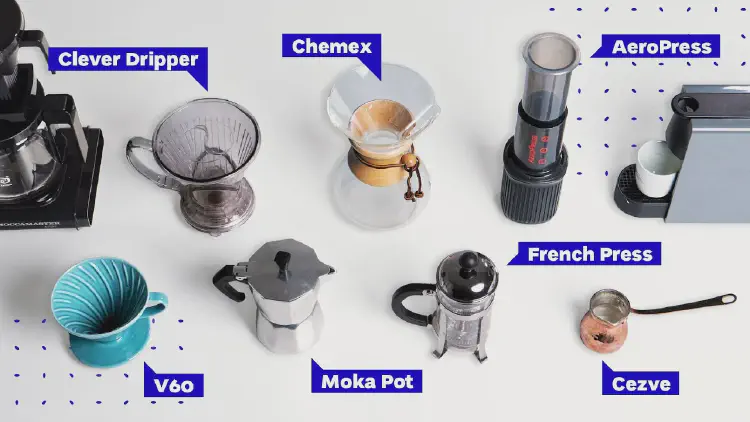
This guide provides a complete overview of the most popular coffee brewing methods. We will explore everything from French Press, Pour Over, and Clever Dripper to AeroPress, Moka Pot, Ibrik/Cezve, Espresso, Drip Coffee Machines, and even Capsule Machines. For each method, we’ll look at the process, discuss its pros and cons, and see how it stacks up against similar brewers, helping you find the perfect match for your coffee routine.
French Press: The Immersion Classic
Let’s begin with the French Press, arguably the most recognized and widely used coffee brewer in the world. Its global popularity stems from its straightforward and user-friendly design. It consists of just two main parts: a glass or metal jar and a plunger fitted with a fine mesh filter.
The brewing process is simple: add coarsely ground coffee to the jar, pour hot water over it, and let it steep for a few minutes. Once steeped, you press the plunger down to separate the grounds from the liquid and pour the finished coffee into your cup.
Because the entire coffee mass is submerged in water for the duration of the brew time, the French Press is a classic example of an immersion brewing method. This technique results in a coffee with a higher body and more blended, less transparent flavors compared to pour-over methods. The liquid is often cloudy because the metal mesh filter doesn’t catch all the fine particles, unlike a paper filter.
Pros of the French Press
- Easy to Use: The process is simple enough for anyone to learn quickly.
- No Paper Filters: The built-in metal filter means no ongoing cost for paper filters.
- Affordable: Basic models are very budget-friendly.
- Large Batches: Available in large sizes (up to 1 liter), making it great for serving multiple people.
Cons of the French Press
- Cleaning: Can be difficult to clean thoroughly.
- Sediment: Leaves fine sediment at the bottom of the cup, which some people dislike.
- Longer Brew Time: Steeping takes several minutes, making it slower than other methods.
- Less Clarity: Produces a muddier flavor profile compared to filter coffee.
Pour Over: The Art of Percolation
The term Pour Over covers a category of brewers where hot water is poured over a bed of coffee grounds, percolating through to extract flavor. The most popular brewers in this family are the Hario V60, the Kalita Wave, and the iconic Chemex.
All these methods typically use a paper filter to separate the grounds, which results in a remarkably clean cup. The process involves placing the brewer over a mug or carafe, adding the filter and coffee, and then carefully pouring hot water in stages. A typical brew takes between two to four minutes. While the V60 and Kalita Wave are drippers that sit on a separate vessel, the Chemex is an elegant all-in-one brewer and carafe. The shape of the brewer—conical for the V60 and flat-bed for the Kalita—also influences how water flows through the coffee, affecting the final taste.
Pros of Pour Over
- Flavor Clarity: Paper filtration creates a very clean, bright, and transparent cup, perfect for highlighting the nuances of light-roasted specialty coffees.
- Control: Offers a high degree of control over brewing variables like water temperature, pour speed, and agitation.
- Aesthetic & Ritual: The process is a calming ritual, and the brewers are often beautifully designed objects.
- Affordable Entry: Basic plastic drippers are inexpensive to start with.
Cons of Pour Over
- Learning Curve: The technique is more complex and can produce inconsistent results without practice.
- Requires More Equipment: You’ll need a gooseneck kettle for precise pouring and a scale for accuracy.
- Ongoing Cost: Requires a constant supply of paper filters.
- Grind is Key: The quality and consistency of your coffee grinder are crucial for good results.
Clever Dripper: The Best of Both Worlds
The Clever Dripper is an ingenious hybrid brewer that combines the best of immersion and percolation. Like a French Press, it allows coffee grounds to steep fully in hot water. However, it features a valve at the bottom that remains closed until you place the dripper on top of a mug.
This action opens the valve, allowing the brewed coffee to drain through a paper filter, similar to a pour-over. This two-stage process offers the full-bodied flavor of immersion with the clean finish of filter coffee. Other popular immersion drippers that use a similar mechanism include the Hario Switch and December Dripper.
Pros of the Clever Dripper
- Consistency: Much easier to replicate results compared to a traditional pour-over.
- Forgiving: Gives you more freedom with grind size and pouring technique.
- Simple Equipment: You don’t need a special gooseneck kettle.
Cons of the Clever Dripper
- Cleaning: The valve mechanism can be tricky to clean thoroughly.
- Aesthetics: Made of plastic, it’s more functional than beautiful.
AeroPress: The Versatile Traveler
The AeroPress is a pressurized immersion brewer that has gained a massive following for its versatility, portability, and speed. Unlike an espresso machine, the pressure comes from your own hands as you push a plunger through a chamber. This process, combined with agitation, extracts coffee much faster than a French Press, typically in just one or two minutes.
There are two main ways to brew with it: the regular method, where the chamber sits directly on your mug, and the inverted method, where the brewer is flipped upside down to allow for a full immersion steep before flipping it back to press. The AeroPress has a huge community built around it, with countless recipes and accessories available, including the smaller, travel-friendly AeroPress Go.
Pros of the AeroPress
- Portable and Durable: Made of sturdy plastic, it’s unbreakable and perfect for travel.
- Fast: Brews a delicious cup of coffee in under two minutes.
- Versatile: Can make anything from a short, espresso-like concentrate to a larger, filter-style cup.
- Easy to Clean: The “puck” of used grounds is easily ejected, making cleanup a breeze.
- Rich Ecosystem: A wide variety of third-party accessories allows for endless experimentation.
Cons of the AeroPress
- Small Volume: It can only brew a single serving (around 250ml) at a time.
- Awkward at First: The process can feel a bit clumsy until you get used to it.
- Cloudy Cup: The coffee can be slightly less clean than a traditional pour-over.
- Overwhelming Options: The sheer number of recipes can be confusing for beginners.
Moka Pot: The Stovetop Espresso-Like
The Moka Pot is an iconic Italian stovetop coffee maker, invented in 1933 by Alfonso Bialetti, that brews a strong, espresso-like coffee. It works by heating water in the bottom chamber, which generates steam pressure. This pressure forces hot water up through a basket of coffee grounds and into the upper collecting chamber.
The resulting brew is stronger than filter coffee but not quite as intense as true espresso, making it a popular base for mixing with milk. Its distinctive octagonal design is recognized worldwide and is featured in many design museums.
Pros of the Moka Pot
- Self-Contained: Heats its own water on the stove, so no kettle is needed.
- Durable & Portable: Typically made of aluminum, it’s tough and great for camping.
- Iconic Design: A stylish and classic piece of coffee history.
Cons of the Moka Pot
- Difficult to Control: It’s hard to manage the temperature precisely, which can lead to a bitter taste.
- Hard to Clean: The narrow chambers and components can be challenging to clean properly.
- Potential Danger: Working with steam pressure on a stovetop requires careful handling.
Cezve/Ibrik: The Ancient Ritual
The Cezve or Ibrik is a small, long-handled pot used for an ancient brewing method still popular in Turkey, the Balkans, and the Middle East. This technique produces a small, very strong, and unfiltered coffee.
To brew, extremely fine coffee grounds (finer than for espresso) and water are combined in the pot and heated until just before boiling. The entire mixture, grounds included, is then poured into a small cup. The fine grounds settle at the bottom, and the coffee is sipped from the top once it has cooled slightly.
Pros of the Cezve/Ibrik
- Simple Method: The process is straightforward and ritualistic.
- No Filters: It’s an unfiltered method, so no extra supplies are needed.
- Beautiful Object: Traditional copper cezves are beautiful works of art.
Cons of the Cezve/Ibrik
- Easy to Over-extract: The high heat can easily lead to a bitter brew if not watched carefully.
- Requires a Special Grinder: The powder-fine grind required is difficult to achieve with most home grinders.
- Small Volume: Brews only a very small, strong cup at a time.
Drip Coffee Machine: The Automatic Brewer
Coffee Drip Machines, or batch brewers, are essentially automated pour-over devices. They handle heating the water and distributing it over the coffee grounds for you. The Technivorm Moccamaster, for example, is a high-end model known for its excellent water temperature stability, quality materials, and longevity, allowing it to brew a large batch of coffee (up to 1.5 liters) that rivals a manual pour-over.
Pros of a Drip Machine
- Convenience: The ultimate “set it and forget it” method—just add water and coffee and press a button.
- Consistency: Removes human error, leading to a consistent brew every time.
- Large Capacity: Ideal for households or offices where multiple cups are needed at once.
Cons of a Drip Machine
- Lack of Control: You have very little control over brewing variables.
- Cost: Quality machines can be expensive.
- Size: Takes up significant counter space.
- Cleaning: Can be difficult to keep internal parts clean.
Espresso Machine: The Ultimate Concentrate
Espresso is a concentrated coffee beverage brewed by forcing a small amount of nearly boiling water under high pressure through finely-ground coffee beans. This method produces a rich, intense shot with a layer of foam on top called crema. Brewing espresso at home is arguably the most complex and expensive path.
Home espresso options range from manual machines like the Flair, which require you to generate pressure by hand, to automatic pump-driven machines, and all-in-one super-automatic machines that grind the beans and brew the shot with a single button press.
Pros of an Espresso Machine
- Exceptional Flavor: A well-pulled espresso shot is an incredibly rich and satisfying coffee experience.
- Foundation for Milk Drinks: It’s the necessary base for making lattes, cappuccinos, and other café favorites.
- Speed: Once the machine is heated and dialed in, shots can be pulled very quickly.
Cons of an Espresso Machine
- High Cost: Espresso machines and the required espresso-capable grinders are very expensive.
- Steep Learning Curve: Mastering the variables to “dial in” a perfect shot takes time and practice.
- Maintenance: Requires regular, intensive cleaning and maintenance.
Capsule Machines: The Peak of Convenience
Capsule machines offer the ultimate convenience by using pre-dosed, single-use pods of ground coffee. The brewing process couldn’t be simpler: fill the water tank, insert a capsule, and push a button. The machine pierces the capsule and forces hot water through it, brewing a coffee similar in strength to a lungo or a diluted espresso.
While originally dominated by large brands, the expiration of Nespresso’s patents has allowed specialty coffee roasters to enter the market, offering high-quality, freshly roasted coffee in a convenient capsule format. This gives consumers access to rare and competition-level coffees that might otherwise be hard to find.
Pros of Capsule Machines
- Extremely Easy: The simplest and most user-friendly method available.
- Fast: Delivers a coffee in seconds with no preparation.
- Clean: There are no messy grounds to deal with.
Cons of Capsule Machines
- Environmental Waste: Single-use pods create significant waste.
- Not Fresh: The coffee is pre-ground and can be stale.
- Expensive: On a per-gram basis, capsule coffee is the most expensive option.
- Not True Espresso: The flavor and texture do not match that of a real espresso.
The Real Secret to Great Coffee
After comparing all these methods, there’s a crucial secret to reveal. No matter which brewer you choose, the most important factor determining the taste of your coffee is the coffee itself.
A great coffee maker cannot fix bad coffee. Rather than spending a fortune on equipment, your first and best investment should be in high-quality, freshly roasted coffee beans and a good grinder.
Here are the key things to focus on:
- Quality: Look for specialty-grade coffee from a local roaster.
- Freshness: Always check the roast date on the bag. Coffee ages and loses its flavor over time.
- Grind Fresh: Grinding your beans just before you brew makes the single biggest difference in taste. The moment coffee is ground, it begins to lose its aromatic compounds. Investing in a quality burr grinder—whether manual or electric—will elevate your coffee game more than any other piece of equipment.